Evidence question / What can a material description establish?
A helmet is not simply a material chosen for its name. Its shell, liner, comfort components and retention system are assembled into a structure intended to work as a whole. Material properties matter, but they are shaped by thickness, density, geometry, ventilation openings, bonding, coverage, manufacturing tolerances and the impact conditions under consideration. A description of one component cannot establish how the complete helmet will behave in every event.
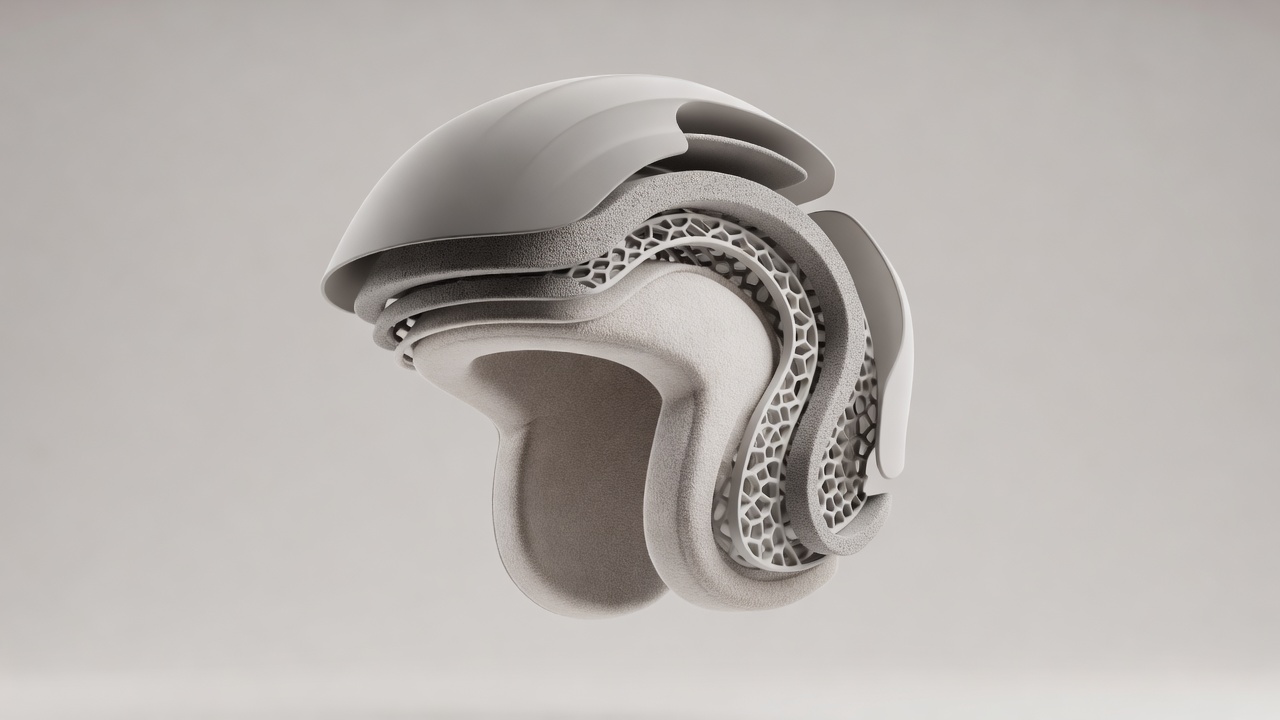
Read the cross-section as a system
The outer shell forms the visible surface and may contribute to structural integrity, distribution of local contact or abrasion resistance according to the design. The liner beneath it is often intended to deform under load, managing energy through a designed response and available crush distance. Comfort padding supports fit and can improve contact, but it should not be confused with the main energy-managing structure. Retention components help keep the helmet positioned. Different constructions vary, so these are general functional descriptions, not a claim about every model.
Illustrative layer sequence only. It is not a product diagram, test result or universal construction specification.
Why material labels are not enough
Two components described with the same polymer or foam family can differ in formulation, density, cell structure and processing. Even identical material stock can behave differently when shaped into different thicknesses or geometries. Bonding and assembly influence how components interact. Openings, channels and local reinforcements can change the available structure. For these reasons, a material name should prompt a question about construction and evidence rather than settle a comparison.
Likewise, a greater amount of material does not automatically demonstrate better performance. A thicker layer could alter the response in ways that depend on its stiffness, available crush distance, the shell above it and the test condition. Evaluating those trade-offs requires measurements from a stated method, with enough context to interpret what was measured. A photograph or marketing description can show a design feature; it cannot substitute for controlled testing.
Energy management is condition-dependent
In an impact, the force-time history and deformation depend on the event and the system. Laboratory studies may use a specified drop, headform and anvil to examine selected responses. A liner may be designed to compress under particular loading conditions and then not return to its original state. Whether a single measurement captures relevant aspects of an event depends on the protocol and chosen outcome. Not all injury mechanisms are represented by one test or one sensor.
Where a report describes material response, read the loading rate, temperature or conditioning, specimen configuration and measurement units. Find out whether the sample is a material coupon, a component or a complete helmet. A coupon test can reveal properties under its own setup, but it does not automatically predict assembled-product performance. A full helmet test provides more system context, yet remains bounded by its fixture, impact location and prescribed conditions.
Compare evidence on like terms
Before comparing products, confirm that they were tested using the same protocol, conditioning, locations and reported measures. If those differ, a numerical comparison may be misleading. Look for sample counts, variation and any uncertainty reported. Ask whether the figure is a certification threshold, a research outcome or a manufacturer specification. Keep the unit attached to every measurement and avoid converting a single result into a broad ranking that the source does not support.
Independent reports and standards can help readers understand how claims were evaluated. Manufacturer documentation can explain construction and intended care. Each source has a role, but none should be made to answer a question it did not examine. An image of a cutaway communicates layers; a test report describes measurements; a care manual guides inspection. Combining them carefully produces a more useful account than relying on any one material adjective.
What readers can reasonably infer
From a verified construction description, readers can identify components and ask how they are intended to interact. From a complete-helmet test, they can infer how specimens performed under the specified method. From neither alone can they infer every wearer’s outcome in every real-world crash. Fit, wear, condition and impact variability remain relevant. If a helmet has taken an impact, follow the manufacturer’s advice; hidden damage may not be apparent by inspection.
The most defensible material comparison is therefore specific: name the construction, cite the protocol and outcome, preserve units and state what remains unmeasured. That approach respects both the engineering work and the limits of the evidence. It also helps readers separate design explanation from proof, without dismissing either.
Layer, interface, response
Soft-lit conceptual cutaway of layered helmet materials. No specific product or test outcome is represented.