Evidence question / What does a protocol actually test?
An impact protocol turns a complicated event into a controlled procedure. It defines elements such as specimen preparation, conditioning, headform, impact surface, location and measurement. These choices allow researchers or laboratories to repeat a test and compare results within a stated framework. They also establish the boundaries of what the result can mean. A standardized procedure is not a miniature version of every crash; it is a defined way to ask a narrower question.
Begin with the method identity
Find the exact standard or research procedure, its edition and the claim being evaluated. A certification test checks requirements specified by a governing standard. A comparative study may use its own protocol to explore differences or mechanisms. An independent rating may combine selected tests or apply a separate scoring approach. These should not be collapsed into a single category called “the rating.” Determine who conducted the work, what specimens were tested and whether the result is a pass/fail decision, measured value or comparative score.
Next, identify sample count and selection. A test on a limited number of specimens provides evidence about those specimens under the described procedure; it does not automatically describe every unit, size or production batch. When available, examine repeated trials, spread, uncertainty and exclusions. A result presented without these details may still be informative, but its precision and generalizability should not be overstated.
Inspect the rig and conditions
Understand how the helmet is supported and positioned. The headform shape, mounting arrangement and retention adjustment can influence the setup. Note the impact surface or anvil geometry and the impact point. Read how the test establishes speed, orientation and contact. Temperature, conditioning, moisture or aging may also be specified. These contextual details are not footnotes: they define the situation represented by the measurement.
Different impact orientations ask different questions. A vertical drop and an oblique impact do not create identical loading. A rotational measure is not interchangeable with a linear measure. A protocol may include selected sites and omit others. When a source reports a measured quantity, keep its unit attached and find how the signal was acquired and processed. Avoid treating a single sensor outcome as a complete account of all possible injury mechanisms.
Accessible method tabs
Use these concise prompts when reviewing a report. They are a reading aid, not a substitute for the original test method.
Setup
Record specimen, headform, conditioning, impact location, surface and orientation. Ask whether the test represents a component or a complete helmet.
Signal
Identify measured quantities, units, thresholds, instrumentation and signal processing. Look for repeatability, sample variation and uncertainty.
Scope
State the protocol’s intended question and the conditions it does not cover. Keep compliance findings separate from broader real-world claims.
Read a rating in context
A rating compresses information. It may be useful for a particular comparison, but readers should look for the method behind it. Check which products were included, whether sizes and models were tested consistently, how results were aggregated and whether the score reflects a threshold or relative performance. A visual badge cannot communicate every methodological decision. If a rating system explains its protocol and limitations, use that documentation rather than inferring from the label.
| Evidence element | Question to ask | Why it matters |
|---|---|---|
| Specimen | Which model, size and sample count? | Defines what was tested |
| Condition | How was it prepared and conditioned? | Context shapes response |
| Outcome | Which measure and unit are reported? | Clarifies what the number represents |
| Scope | What was omitted or not measured? | Prevents overgeneralization |
Keep comparison fair
Comparisons are most interpretable when methods, conditions and outcomes align. If one report measures a different response, uses different impacts or summarizes values differently, a direct numeric ranking may be misleading. Explain the mismatch rather than hiding it. Where reports provide original data, cite that source and preserve the stated units. Where only a secondary summary is available, identify it as such and avoid presenting it as an independent test report.
It is also important to distinguish measurement from interpretation. A sensor output is an observation produced under a method. The significance of that observation depends on the protocol, threshold, validation and research question. A standard may define acceptance criteria, but passing does not establish protection in every event. A study may offer mechanistic insight without creating a consumer certification. Readers benefit when these distinctions are made explicit.
What the method leaves open
No finite protocol samples every impact direction, surface, speed, fit, age, condition or wearer. Laboratory control improves repeatability but narrows the conditions under study. Field observations can add context, while bringing their own challenges in exposure measurement and event reconstruction. Evidence becomes stronger through complementary methods, not through pretending one test can answer everything.
When summarizing a result, name the protocol, specimen, outcome and major limits. Say “under the reported test conditions” where appropriate. Do not convert a pass into a guarantee or a research measurement into an unsupported safety score. That discipline is not excessive caution; it is faithful reading of the evidence.
Source note: refer to the named standard, its current official text and the original research report for definitive methods and interpretation.
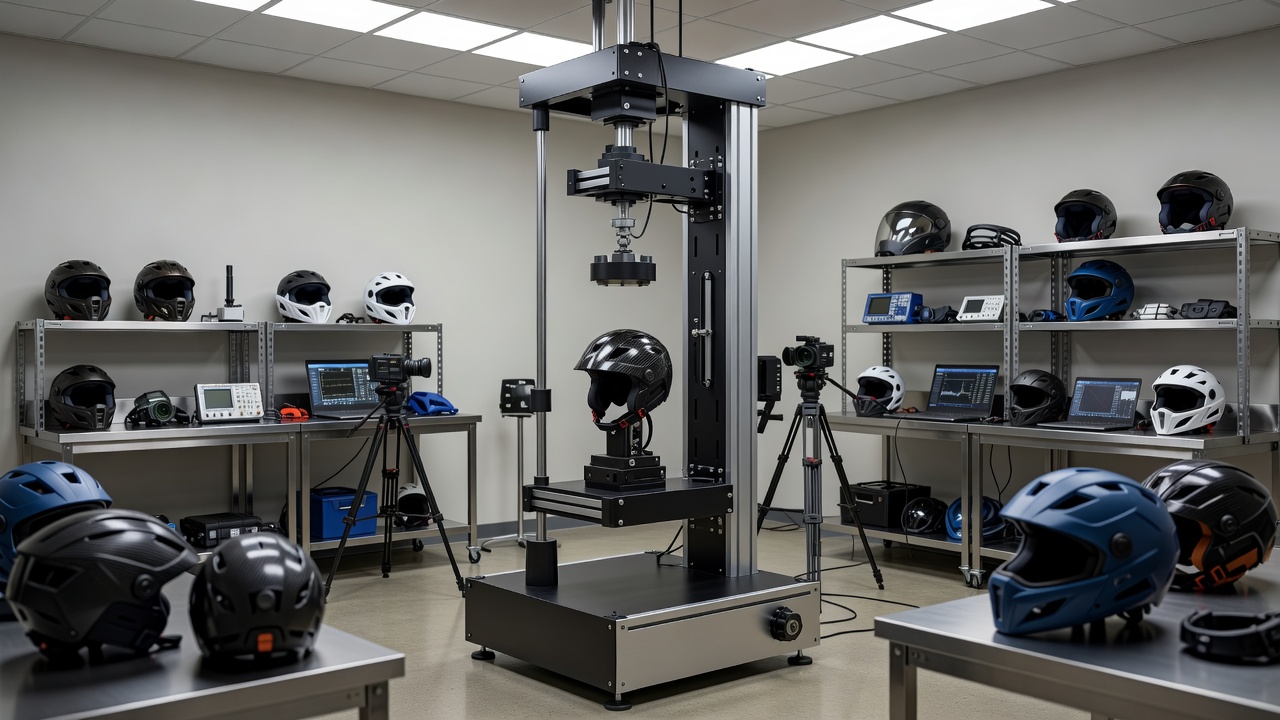
Controlled impact apparatus
Supporting laboratory image should be read as general research context, not as a specific test or result.